From Failures to Learnable Worlds: Policy-Conditioned Environment Generation for Navigation Agents
WEDGE: Weakness-guided Environment Design, Generation, and Evaluation
The agent fails
LLM mines the weakness
The LLM proposes a feature; it is validated on every episode.
Find the weak regime
Below the agent’s average is the weak regime: we generate there.
Generate environments (new layouts)
New layouts; red: path before the Sofa is seen; blue: the agent’s rollout.
Adapt
Same episode after training. Left: route to the Bed; right: what the agent sees.
Different agents fail for different reasons
Same task, three pretrained agents, three different weakness profiles. Each cell is how much an agent's success rate drops between the easy third and the hard third of its diagnostic episodes for that property. The biggest drop per agent is its top weakness.
LLM-guided weakness discovery
Sample successful and failed episodes, ask the LLM for a feature that separates them, and validate it on the whole diagnostic set. Rejected candidates go back with their reason; validated ones become the mined weakness.
15 successes and 15 failures.
available fields
s scene: p planner: cat target category · Math availableEach weakness maps to the factor that controls it
Target visibility is controlled by where the object sits, so we re-place it. Blind-path ratio and target-room remoteness are layout properties, so we generate new layouts. Candidates are kept only inside the agent's weak regime.
Training on the generated environments fixes the failures
Validation episodes the pretrained agent failed and the adapted agent solved after one round. Left: before. Right: after. Paths are logged positions over the simulator’s top-down render.
The gains generalize to real HM3D scans
Uni-NaVid was diagnosed and adapted in ProcTHOR only. On held-out HM3D episodes the pretrained model failed and the adapted model solved, here are its route on the scan’s navigation map and what it saw along the way. The route is drawn as the video plays.
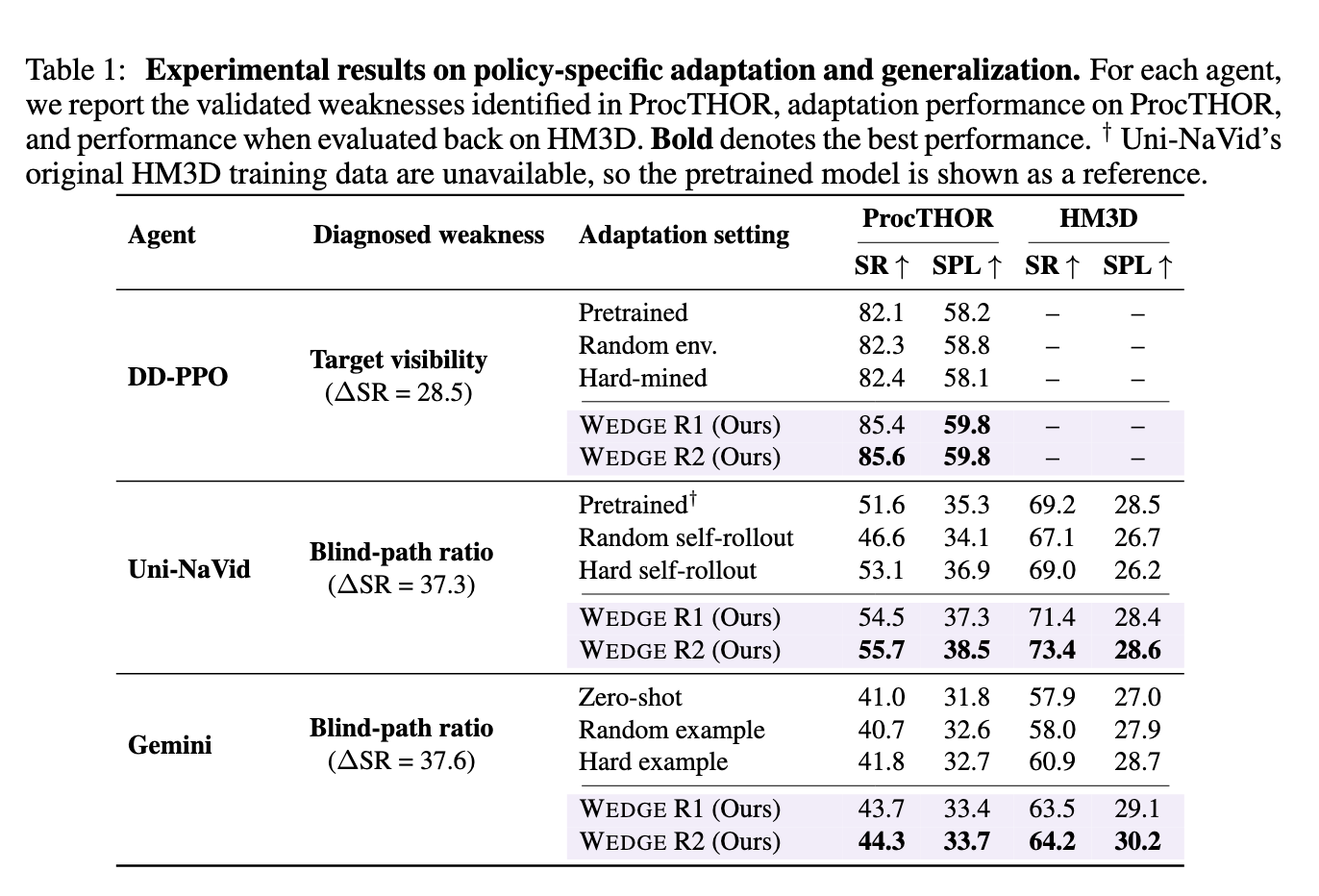
Experimental results on policy-specific adaptation and generalization
For each agent: the validated weakness, adaptation on ProcTHOR, and evaluation back on HM3D. Baselines use the same recipe and budget with environments or examples chosen at random or by failure alone.
BibTeX
@article{zhang2026wedge,
  title   = {From Failures to Learnable Worlds: Policy-Conditioned Environment Generation for Navigation Agents},
  author  = {Zhang, Yue and Lin, Han and Wang, Zun and Huang, Yidong and Khan, Zaid and Bansal, Mohit},
  journal = {arXiv preprint},
  year    = {2026}
}